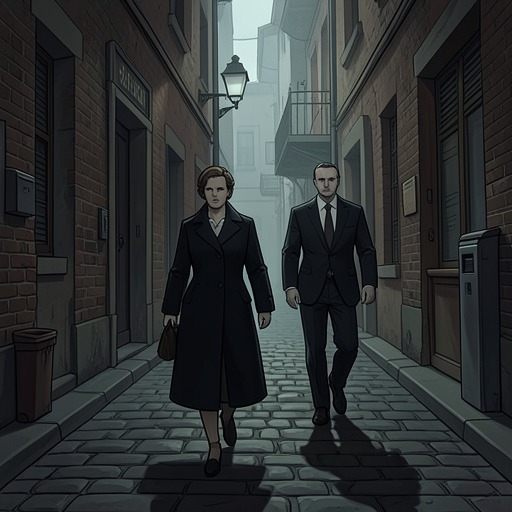
German officer
Kiss of the Spider WomanThe German officer is a young, high-ranking counterespionage official in Paris during the German occupation of France. In the film story Molina recounts to Valentin, he is at once a representative of the occupying power and Leni’s beloved. Their relationship brings private feeling into direct conflict with political allegiance: he speaks of service to Germany as a noble cause, while Leni insists that her own loyalty is to France. His final appearance makes that conflict tragic, as he reaches Leni after she has been mortally wounded and is left to mourn her alone.
Identity and Position
The officer introduces himself as the man in charge of German counterespionage operations in Paris. He is young and high-ranking, and his first approach to Leni comes after the police have detained her because of her friendship with a murdered woman. Leni is released so she can perform, and the officer visits her dressing room after the show to apologize for the trouble she has faced. He is not in uniform; his formal evening clothes and personal manner distinguish this first meeting from an official interrogation.
He tells Leni that the flowers he has brought come from the Upper Palatinate, where he was born, near a lake among snow-covered mountains. The detail gives his introduction a personal register, but his politics soon become just as prominent. At supper, Leni explains that she comes from Alsace, a border region whose flag has changed, yet says she has been taught to love France. The officer answers that Germany is committed to removing the enemies of Europe. His confidence presents occupation as a righteous national mission, while Leni questions how that occupation could serve her country.
Courtship and Emotional Contradiction
The officer’s attention to Leni develops through gestures of apology and invitation. He takes her to a cabaret after her performance, then offers to take her home. When she notices a shadow in an upstairs window and asks not to be left alone, he brings her to his apartment. There, music becomes a language neither of them has to translate politically. Leni says that music is the only thing she loves from his country; as a piece plays, the officer explains what it means to him and becomes so moved that tears fill his eyes.
That response unsettles the image of invulnerability he has presented. He has spoken of a patriotic man becoming godlike through love of country and knowing no fear, yet the music reveals him as emotionally vulnerable. Leni recognizes this human feeling in him. The scene does not resolve the political difference between them, but it makes their attraction more complicated than a simple opposition between an occupier and his French lover. The intimacy that follows is conveyed through Leni waking in his bed and addressing him as someone whose beliefs she is now trying to understand, not merely resist.
Political Breach
The relationship changes when Leni overhears the officer advising that two black-market criminals be executed. She challenges his claim to fearlessness by asking whether killing a defenseless enemy might itself arise from fear of facing that enemy in the future. He does not understand her point, and she changes the subject rather than openly revealing what she has heard. The discovery nevertheless alters her view of him: his readiness to sanction death makes him seem less admirable to her.
Leni acts on that judgment. Using a contact she obtained through the Clubfoot, she arranges to pass the Maquis a secret about the arsenal. Their meeting is planned for the theater, where her rehearsals provide cover. Before she can give the information, a Berlin invitation arrives, accompanied by an official connected with the occupation authorities, and she must leave at once. Her political work and the officer’s world thus collide even when he is not present: the relationship has given her access to the occupying power, but it has not displaced her commitment to France.
Final Reunion and Loss
Later, the officer and his patrol follow the tracks of a car through the rain as they search for Leni. They eventually reach the place where she is being held. The Clubfoot is already dead, and the driver who has attacked her manages to shoot her before the officer can secure her escape. The officer arrives as Leni is losing her strength. She tells him that she loves him and imagines that they will soon be together again in Berlin; he realizes that she has been gravely wounded and holds her as she dies.
The film’s closing image shifts from rescue to memorial. In Berlin, the officer places flowers on a monument to heroes, where Leni is represented as a statue with her arms extended. He leaves in tears, while her figure remains behind, alone beneath an inscription promising that the fatherland will remember its heroes. The ending turns the officer’s earlier language of national destiny into an image of private bereavement: the state commemorates Leni, but the person who loved her must walk away without her.
Narrative Role
The German officer is not given a narrated history beyond his birthplace, rank, and work in counterespionage. His significance instead emerges through contrasts staged in the film story: patriotic certainty beside private emotion, the language of national duty beside Leni’s refusal to abandon France, and the hope of reunion beside her death. His tears over music reveal feeling without proving that his political convictions have changed; the story leaves that distinction intact. Because Molina recounts the film to Valentin, the officer’s courtship, moral rupture, and loss also reach the reader through an act of storytelling, in which intimate scenes and public violence are joined within the same tragic arc.